Wednesday, November 23, 2011

...with style and Grace


Grace Kelly by Andy Warhol
Every so often, an event happens in your life that you can recount as if it were yesterday.  So strong was the impact of it that you remember just about every detail of what you were doing when you, "heard the news".  We all have shared these moments in the death of Diana, Princess of Wales, or the terrorist attacks on the world trade center.  
I was in Europe, when I heard the news of the car crash that took the life of Her Serene Highness Princess Grace of Monaco.  I had just been in that beautiful principality the week before and so the news was particularly shocking to me.  It seemed surreal and everyone in Europe was discussing it.
Last week I went to the Grace Kelly exhibit at Toronto's Lightbox.  For those of you who are not from Toronto, the Lightbox is the headquarters for the Toronto International Film Festival, (TIFF).  Along with the theaters and gift shop, their is also a small gallery space dedicated to rotating exhibits.  When I first learned that this show was coming to Toronto I was very exited.  I was disappointed that I had missed it when it opened at the Victoria and Albert Museum in London and so my expectations were quite high.  The show had previously premiered at the Grimaldi Forum in 2007 in Monaco and was now in circulation.


Grimaldi Forum, 2007
V & A exhibit
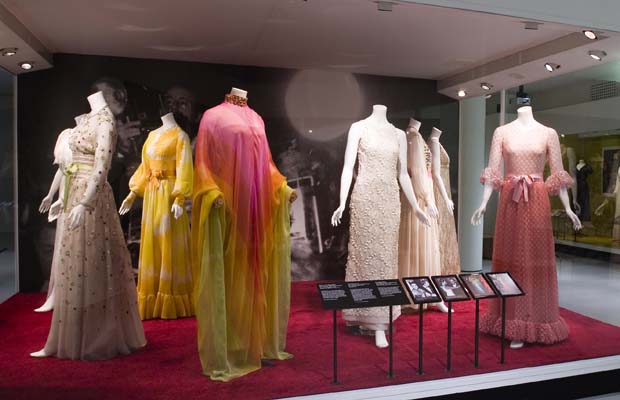
Naturally, I expected to see the entire show from the U.K., but unfortunately the limited space meant that the Toronto show was much smaller and the disappointment didn't end there.  The accompanying descriptive text was vague at best and did little to provide any real insight into the life of the film star or princess.  I found myself wandering through the exhibition space without any sense of direction or purpose.  Along with a collection of correspondence, mostly in the form of congratulatory telegrams, magazine covers and film footage, there were displayed a handful of Princess Grace's dresses from 1956 to 1982.  Unlike the exhibit at the V&A, in Toronto we were not allowed to take our own photographs, so the images you see posted today have been edited from the shows in London and Moscow, with a few taken from the Globe & Mail press release.  

The show opened with the image painted by Warhol of Grace (above) accompanied by a display case containing three pairs of gloves.  The relationship between the two escaped me and all I remember thinking was how small her hands were!  

Exiting TIFF show

Engagement photo, Dior


At right and above (top row) dress worn by Grace on April 18, 1956 for the civil service ceremony performed in Monaco.  The colour was described as, "Ashes of Rose" taffeta under applique of Alencon lace.  If you look closely at the hemline, the lace has been scalloped to allow for the contrast of the silk taffeta to show through.  The suit was designed, along with Grace's wedding gown, by MGM's Helen Rose and exemplifies the tailored look made fashionable by her favorite designer, Dior.

The high light of the show should have been another dress designed by Helen Rose and that, of course, was the wedding dress worn at St. Nicholas Cathedral the next day.  Undoubtably, this dress was the crowning achievement of Rose's career and the finished creation was valued at $7,200 at the time.  It took 6 weeks of work by three dozen seamstresses and consisted of a long-sleeved gown with a fitted bodice with an overlay of 125 year old rose point lace.  The skirt of silk taffeta, peau de soie, tulle and lace was complimented by a circular veil of tulle that contained ninety yards of fabric!  After the wedding Grace donated the dress to the Philadelphia Museum of Art.  

Helen Rose wedding gown


I was already aware that the original dress was too fragile to come to Toronto and that a reproduction was to be shown and for me this was the biggest disappointment of all.  Not the fact that a reproduction had to replace the original, I understand the ephemeral nature of textiles, but that the reproduction was so poorly executed.  The textiles were cheap and the skirt did little to support the silhouette achieved by Rose's work.  It looked as if it had been made by one of those cheap knock off houses in the garment district.
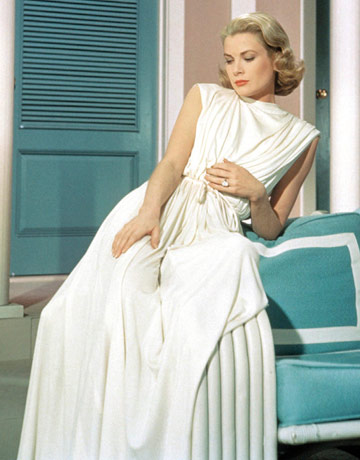
Edith Head for "High Society"
If there was any order at all to the show it was the subdivision of Grace Kelly, movie star, from Princess Grace of Monaco.  I understand that the V&A and Moscow shows paid more attention to this aspect of her life which I found ironic considering the venue in Toronto.  The cabana wrap above, worn in a pool scene in the movie, High Society, was the only movie costume included in the Toronto show and only one of two pieces designed by Grace's dear friend, Edith Head.  The other was the dress and coat worn to the Oscar's when she won for best actress for the Country Wife.
Installation at TIFF, Lightbox show

Oscar night
At the Grimaldi, Moscow and Victoria and Albert Museum shows, more examples of the Hollywood connection were included.  One question that the Toronto show did not answer, but which I would have liked to have known, was "Did Grace keep and incorporate these iconic dresses into her own wardrobe or had they been assembled from various outside sources for the purposes of the exhibition?"  Either way, I have included them here, (below).  It seems that the films High Society and Rear Window were the sources chosen for the exhibition halls.  Both examples of the work of Edith Head.
Edith Head, Rear Window
The life of the Princess was told through a variety of sources including film footage taken either by her or of her.  Personally, I found the family vacation movies less interesting than my own.  Standing around in front of a screen projecting the privileged class enjoying their privileges provided nothing more than the opportunity to capture our imagination with the scenes of supposed "normality".  If, as the descriptive text leads us to believe, Grace learned anything about movie making from Hitchcock, it escaped me.  Although I will admit, the yachting and beach scenes were full of sea gulls!


The news footage of some of the Grimaldi's charitable works, including balls, were much more interesting.  Below, the Moscow exhibit had the space to display two costume gowns worn by the Princess at these masked balls.  In the background, you can see an enormous second empire inspired gown worn by Princess Grace in the photo above.

Moscow exhibit
The show did share one interesting and entertaining tidbit.  Grace Kelly was true to her own style which was relatively clean in line coupled with immaculate attention to construction and details.  She saw fashion as an art form and appreciated the technical side of fine craftsmanship.  She was a practical dresser and had a way of choosing the most appropriate ensemble to correspond with the demands of the occasion.  One such incident involves a dress that Grace brought with her when she arrived in Monaco for her new life.  It was a simple floral dress that she had modeled for the pattern company, McCall's.  Not intending to wear this dress to a public reception, she was forced to due to a power outage at the palace.  Her luggage had yet to be completely unpacked and nothing had been pressed.  The only dress that had survived the voyage was the polyester number worn below.  What a coupe for McCall's! You just can't buy advertising like that.
McCall's dress
Once again, TIFF dropped the ball.  While the dress was displayed, the silhouette was lost.  The required crinoline that provides the shape of the skirt was not there!

1955 McCall's catalogue
As both an actress and princess, Grace was in the enviable position to have both the financial resources and occasions to patronage some of the finest couture houses of the 1950's until her death.  Dior, Balenciaga, Chanel, Rouff all found their way into her wardrobe.  

Left to right. Dior (maternity dress), Balanciaga, Chanel

Photo by Howell Conant
Maggie Rouff
Dior, 1972
As well as clothing, personal items that helped to accessorize the actress' and princess' personal style were showcased.
A collection of personal jewels


"Kelly" bag

One year before her death, Princess Grace wears Dior at a benefit at London's Barbican.  It is here that she meets Diana for the first time.  Ironically, Diana will represent Britain's royal family at the funeral of Princess Grace of Monaco.
In Dior at the Barbican with Lady Diana Spencer & HRH Prince Charles

As disappointing as the Toronto exhibit was, I am still glad that I made the pilgrimage to worship at the shrine of fashion and "material culture."  Her clothing could have been presented on a rolling dress rack and I still would have discovered a technique, colour or line that would have inspired my own work. 
With the upcoming sale of Elizabeth Taylor's estate at Christie's, in New York, it is hoped that perhaps another exhibit of the fashionable taste of one of Hollywood's icons, will be shared with the public.


Thursday, October 27, 2011

Paris, 1855

The Event:  The Exposition Universelle of 1855 was the second international exhibition in an age that would come to celebrate its industrial and artistic accomplishments.  Following on the heels of the Great Exhibition of 1851, held in High Park, London, it was slightly less successful attracting a mere 5,162,330 visitors.  Covering 39 acres of exhibition space along the Champs-Elysees, it was physically larger than its predecessor but financially, it was a bust.  From May 15- Nov. 15, 1855, It was as much a celebration for the recently restored monarchy of Napoleon III as it was an acknowledgement of France's industrial might.

Agriculture, Industry and the Beaux-Arts were housed in pavilions not unlike the Crystal Palace of England's Joseph Paxton.  Here, 34 countries displayed their best offerings in the hopes of being awarded a coveted ribbon or royal patronage.

Singer Sewing Machine, display


Being interested only in the "material world", I will choose to omit the contributions offered in the agriculture and industry pavilions.  Our focus will be on the Beaux-Arts.
Beaux-Arts Pavilion

If you ever get to Paris, you must visit the Musee d'Orsay.  Once an old train station, it is worth the visit just to view the architecture.  If you enjoy the decorative arts of the 19th century, then be sure to visit these galleries, where, much like the Victoria and Albert museum in London, many items from this exhibition are on display.  Particularly wall coverings and some furnishings.


While 19th century design can appear daunting and confusing to the student, eventually with a little  study it can be mastered quite easily.  Understanding these movements in architecture and the decorative arts can go a long way to understanding fashionable taste and dress.  While the English were engrossed in the design elements of a medieval past, they had been making this association since the mid 18th century, the French, under Napoleon III and his consort Eugenie, revisited the royal courts of the ancien regime.  Eugenie in particular had an interest in the age of Marie Antoinette and was herself responsible for the eventual preservation of the Chateau of Versailles, it was scheduled for demolition and re-development in the 1860's!, and the restoration of the crown jewels.
 
Typical of mid 19th century interpretations, a less than scholarly approach yielded some rather fantastic ideas.  Married to industry and the might of the machine, the results could be quite horrific.  While the movement we now recognize as the Rococo period had ended by the reign of Louis XVI, it was more than acceptable to borrow from it in this new revival under the "Second Empire".
Rococo Revival desk with porcelain placques
Installing Textile Display

Dress silk from Lyon.  Under the patronage of the Empress and eventually through the demand by couturiers such as Worth, the silk industry in France will supply some of the most incredible designs for dress and furnishings.

Here, the design elements reflect the swag, garland and smaller lover's bow knot details much in favor under the reign of Marie Antoinette, but the larger red patterned bows and printed Chantilly lace pattern give this textile a more contemporary mid 19th century twist.


Collection, The Hague


Manufacturers were quick to realize the potential for creating textiles particularly suited to the fashion trade.  These fabrics were printed or woven, "en disposition" and were well suited to the flounces required of the fashions of the period.

Opposite, a receipt for a textile of apple green, which would have been printed with "co-ordinates" of solids, trimmings and fillers such as dots or "ditsie's" not dissimilar to the dress below.
Note how the sleeves are cut from the same fabric of the flounce but in such a way as to appear woven "en disposition". Such effects continued to be achieved throughout the remainder of the century and appear again in the designs of the Edwardian age.


Brooklyn Museum
Printed, painted or woven treatments were all possible techniques in the manufacture of these silks, as well as, light weight muslins. The image below is of evening dress.  The shorter sleeve, lower neckline and richness of the material would have been suitable for a matron of the period.  The embossed velvet on the flounces would have made the skirt fairly heavy, but the silk ground would have been lighter than paper.  As many as six petticoats of varying weights and stiffness would be needed before the invention of the cage crinoline the following year.  The cabbage rose, as a motif, will be very common in many examples of textiles in this period.


Official reception of Queen Victoria
In August of 1855, Queen Victoria and Prince Albert paid a state visit to France.  Among the many receptions and state balls, was a visit to the Expostion.  Queen Victoria had enjoyed England's own in 1851 and commented in her diary at that time of the novelty of being able to shop for goods.  Shopping seemed to be a past time that she enjoyed, and she did her share in Paris.

Purchased for Albert's study, this writing table is a more accurate interpretation of the styles of the French court under Louis XVI.  The tapered leg, ormolu mounts, rectilinear lines are faithful to the 18th century.  The woods are not.  This style will compete, but not, replace the interest in the more curvilinear rococo revival which will remain popular for the rest of the century.

Napoleon III, Queen Victoria, Empress Eugenie, Prince Albert
For the state visit to France, Prince Albert is said to have designed the textile for the dress below.  His inspiration was apparently an english country garden.  Printed or painted silks were popular imitations of those from the 18th century.  This fabric, with it's more linear approach to the design, betrays it as 19th century.  An 18th century pattern would have been more meandering in it's execution.
Royal Dress Collection, Kensington Palace


Skirt detail


Perhaps the fashionable, if not dull, Madame Moitessier, saw this silk at the Exposition Universelle the year prior to the painting of her portrait by Ingres.  For 1856, this gown is the height of fashion and a rather daring choice for both patron and painter.  Generally, painters preferred their sitters to wear solids. In this way, the portrait was less likely to look "dated" over time.  The painted, or perhaps, woven silk with co-ordinating ribbons and fringe trim are captured beautifully here.  The posture of the subject is more classical in inspiration than the costume chosen.  The sitter competes with her dress for the attention of the viewer and engages us directly with her gaze.
For those of us who love to reproduce, an amazing example.  Source unknown and uncredited.

The 19th century exhibitions were important transmitters of taste in all aspects of the arts.  In an age of rising consumerism coupled with the insecurities of an uncertain middle class, design was becoming more homogeneous.  What would be fashionable in Paris was as likely to be in step throughout western Europe and her colonies.