Thursday, October 27, 2011

Paris, 1855

The Event:  The Exposition Universelle of 1855 was the second international exhibition in an age that would come to celebrate its industrial and artistic accomplishments.  Following on the heels of the Great Exhibition of 1851, held in High Park, London, it was slightly less successful attracting a mere 5,162,330 visitors.  Covering 39 acres of exhibition space along the Champs-Elysees, it was physically larger than its predecessor but financially, it was a bust.  From May 15- Nov. 15, 1855, It was as much a celebration for the recently restored monarchy of Napoleon III as it was an acknowledgement of France's industrial might.

Agriculture, Industry and the Beaux-Arts were housed in pavilions not unlike the Crystal Palace of England's Joseph Paxton.  Here, 34 countries displayed their best offerings in the hopes of being awarded a coveted ribbon or royal patronage.

Singer Sewing Machine, display


Being interested only in the "material world", I will choose to omit the contributions offered in the agriculture and industry pavilions.  Our focus will be on the Beaux-Arts.
Beaux-Arts Pavilion

If you ever get to Paris, you must visit the Musee d'Orsay.  Once an old train station, it is worth the visit just to view the architecture.  If you enjoy the decorative arts of the 19th century, then be sure to visit these galleries, where, much like the Victoria and Albert museum in London, many items from this exhibition are on display.  Particularly wall coverings and some furnishings.


While 19th century design can appear daunting and confusing to the student, eventually with a little  study it can be mastered quite easily.  Understanding these movements in architecture and the decorative arts can go a long way to understanding fashionable taste and dress.  While the English were engrossed in the design elements of a medieval past, they had been making this association since the mid 18th century, the French, under Napoleon III and his consort Eugenie, revisited the royal courts of the ancien regime.  Eugenie in particular had an interest in the age of Marie Antoinette and was herself responsible for the eventual preservation of the Chateau of Versailles, it was scheduled for demolition and re-development in the 1860's!, and the restoration of the crown jewels.
 
Typical of mid 19th century interpretations, a less than scholarly approach yielded some rather fantastic ideas.  Married to industry and the might of the machine, the results could be quite horrific.  While the movement we now recognize as the Rococo period had ended by the reign of Louis XVI, it was more than acceptable to borrow from it in this new revival under the "Second Empire".
Rococo Revival desk with porcelain placques
Installing Textile Display

Dress silk from Lyon.  Under the patronage of the Empress and eventually through the demand by couturiers such as Worth, the silk industry in France will supply some of the most incredible designs for dress and furnishings.

Here, the design elements reflect the swag, garland and smaller lover's bow knot details much in favor under the reign of Marie Antoinette, but the larger red patterned bows and printed Chantilly lace pattern give this textile a more contemporary mid 19th century twist.


Collection, The Hague


Manufacturers were quick to realize the potential for creating textiles particularly suited to the fashion trade.  These fabrics were printed or woven, "en disposition" and were well suited to the flounces required of the fashions of the period.

Opposite, a receipt for a textile of apple green, which would have been printed with "co-ordinates" of solids, trimmings and fillers such as dots or "ditsie's" not dissimilar to the dress below.
Note how the sleeves are cut from the same fabric of the flounce but in such a way as to appear woven "en disposition". Such effects continued to be achieved throughout the remainder of the century and appear again in the designs of the Edwardian age.


Brooklyn Museum
Printed, painted or woven treatments were all possible techniques in the manufacture of these silks, as well as, light weight muslins. The image below is of evening dress.  The shorter sleeve, lower neckline and richness of the material would have been suitable for a matron of the period.  The embossed velvet on the flounces would have made the skirt fairly heavy, but the silk ground would have been lighter than paper.  As many as six petticoats of varying weights and stiffness would be needed before the invention of the cage crinoline the following year.  The cabbage rose, as a motif, will be very common in many examples of textiles in this period.


Official reception of Queen Victoria
In August of 1855, Queen Victoria and Prince Albert paid a state visit to France.  Among the many receptions and state balls, was a visit to the Expostion.  Queen Victoria had enjoyed England's own in 1851 and commented in her diary at that time of the novelty of being able to shop for goods.  Shopping seemed to be a past time that she enjoyed, and she did her share in Paris.

Purchased for Albert's study, this writing table is a more accurate interpretation of the styles of the French court under Louis XVI.  The tapered leg, ormolu mounts, rectilinear lines are faithful to the 18th century.  The woods are not.  This style will compete, but not, replace the interest in the more curvilinear rococo revival which will remain popular for the rest of the century.

Napoleon III, Queen Victoria, Empress Eugenie, Prince Albert
For the state visit to France, Prince Albert is said to have designed the textile for the dress below.  His inspiration was apparently an english country garden.  Printed or painted silks were popular imitations of those from the 18th century.  This fabric, with it's more linear approach to the design, betrays it as 19th century.  An 18th century pattern would have been more meandering in it's execution.
Royal Dress Collection, Kensington Palace


Skirt detail


Perhaps the fashionable, if not dull, Madame Moitessier, saw this silk at the Exposition Universelle the year prior to the painting of her portrait by Ingres.  For 1856, this gown is the height of fashion and a rather daring choice for both patron and painter.  Generally, painters preferred their sitters to wear solids. In this way, the portrait was less likely to look "dated" over time.  The painted, or perhaps, woven silk with co-ordinating ribbons and fringe trim are captured beautifully here.  The posture of the subject is more classical in inspiration than the costume chosen.  The sitter competes with her dress for the attention of the viewer and engages us directly with her gaze.
For those of us who love to reproduce, an amazing example.  Source unknown and uncredited.

The 19th century exhibitions were important transmitters of taste in all aspects of the arts.  In an age of rising consumerism coupled with the insecurities of an uncertain middle class, design was becoming more homogeneous.  What would be fashionable in Paris was as likely to be in step throughout western Europe and her colonies.

Sunday, October 16, 2011

Fashion: Fiddle-Dee-Dee


The Debate:
Over the past two weeks I have been monitoring the response to a question that I posed to fellow costume enthusiasts regarding the accuracy of historical detail in period films.  It seems that many have an opinion on this topic and some are quite passionate.
I heard from professional costume designers who justified their creative anachronistic choices in the name of character development.  While some stressed the interference of directors and other production designers on the project.  I heard from vintage dealers who supplied through rental or sales, actual pieces or textiles.  They blamed the lack of research on the part of the designer or subordinate who would ask for "the 1920's, but would be disappointed in the silhouette and choose the 1940's instead!
It seems many of us, at least those dedicated to the material culture of the past, have had very distracting and consequently, disappointing viewing experiences, by the inaccuracies of the production designer.  I for one have had many such experiences and have often left the theater or turned the channel feeling frustrated.
The recent production of the Tudors is a case in point.  I don't know which was worse.  The choice of textiles for Renaissance England, which I could forgive, or the fact that Henry VIII never gained any weight!  The popularity of the show among younger viewers, who usually accept anachronisms without question, infuriated the historian in me.
Does this mean that my interpretation is any more valid than the choices made by the production designers?  It certainly does not.  But I do have to admit, that as a costume historian, I know that the efforts of Masterpiece Theatre never disappoint, on the contrary, they usually inspire and the slowest of plot lines can be forgiven anything if the costuming is right.
The Example:
For those of you who know me well, you know the impact that the film version of Margaret Mitchell's, "Gone With the Wind" had on me.  I first read the book in the winter of 1974.  In July of that year, it came to our local theater, the Roxie!  Unable to find anyone who shared my desire to view the film, how many other 14 year old boys are interested in the trials and tribulations of a southern belle, I chose to go alone.  For the grand sum of 50 cents, ironically the same price as the 1939 ticket, I settled in for what I was expecting to be a regular 2 hour show.  I even got up to leave at intermission, upset that only half the movie had been filmed, when I overheard two women behind me talking about the splendor of the second half.  Thank God for the empowerment of eavesdropping!  By the time that the film had finished, like everyone else, I had cried and was sure that somehow Scarlett would get him back.
When my parents picked me up at the theater I rattled on about the magnificent costumes, certain that I had seen the most accurate representation of the period.  So engrossed was I during the film, that the absence of many secondary characters and plot lines were hardly even noticed.  I immediately began to re-read the novel that summer.  I think that I have read the novel at least 12 times and seen the movie just as often.
In 1987-88, the Los Angeles County Museum of Art launched an exhibit, "Hollywood and History: Costume Design in Film".  I never saw the exhibit, but several years latter, Edward Maeder spoke on the subject to the Costume Society of Ontario.  When he addressed the work of costumer Walter Plunkett, I naturally was very interested.
As part of his advertising campaign, Selznick released a number of articles on the pre-production planning of his epic film.  His search for the actress to play Scarlett O'Hara is legendary.  He used a similar approach around the costuming efforts of Walter Plunkett.
Looking for authenticity, or at least giving the appearance to be, Plunkett's travels in the deep south to source first hand examples of civil war era fashions, would be as familiar to the readers of the hollywood tabloids as the hype around who would play Scarlett O'Hara.  It was a stroke of marketing genius and it succeeded in keeping the publics attention over a period of nearly 3 years from the publication of the novel to the premier of the movie.
Maeder, in his article, "The Celluloid Image:  Historical Dress in Film", addresses many problems with the costuming efforts of GWTW and other period productions of this golden age of film.  I won't go into them here, but suggest for those of you who are interested in the topic to try and find a copy of the exhibition catalogue.
I thought instead that it might be fun to see what would have happened to the movie if it were to be produced today by Masterpiece Theatre.
Wardrobe assistant with Leigh's costumes for GWTW
Working with Mitchell's original text, the same approach that Plunkett would have taken, I began to look for references to help with my costuming efforts.  Surprisingly, in a novel of 1039 pages and rich with descriptive prose, Mitchell provided very little detail about the specifics of dress.  I was surprised myself upon my most recent re-reading, expecting to find wonderful lush descriptions.  For Plunkett, this would have been somewhat of a blessing.  He would remark in an interview, that if he had followed Margaret Mitchell's text to the letter, that every important dress in the movie would have been green!  Even the now iconic red velvet number, worn to Ashley Wilkes' surprise party, should have been green.
Mitchell does provide colour and textile descriptions, and she goes on at length about war time hardships and the value of blockade run goods, but otherwise, details are left to the imagination of the reader.  Based on the written account of the dress worn by Scarlett, as the scarlett woman, it would probably look more like the example from Harper's Bazaar below.  It was described as a green watered silk gown with pink velvet roses falling over the bustle!
Mitchell will provide further scanty descriptions of Scarlett's wardrobe for the "Barbecue Dress" of sprigged green muslin and the "Drapery Dress".  Both of which have become the most iconic dresses of the film.

Plunkett sketch

True to the text, this dress was meant to be worn in both the opening scene with the Tarleton twins and the Twelve Oaks barbeque.


Selznick would later have this scene re-shot, actually five times!  The white ruffled dress would be chosen as a replacement to make Scarlett appear more "virginal".


Perhaps in the hands of a costumer more sympathetic to historical accuracy this ensemble, from the collection of the Metropolitan Museum of Art, would have been copied.  It certainly would have made Scarlett's life a little easier.  The long sleeved version was ideal for her morning arrival at Twelve Oaks and with the simple change of bodice, after her nap, she could have avoided the unpleasant scene with Mammy when dressing earlier that morning.

"No you ain't.  You can't show your bosom 'fore three o'clock".  But of course, some important character development would have been sacrificed.

What can I say.  There was nothing like it in the world, and there never will be.  Plunkett followed the text verbatim and not a single viewer has ever been disappointed.  I can still feel the rush of adrenalin when I first saw this gown.


Through some cleaver detective work, it is possible for the reader to establish a time line for one costume in particular.  The only wedding gown to be created for the film, despite our heroines three marriages, is seen within the first 15 minutes of the picture.  According to the text, Scarlett O'Hara comes down the staircase of Tara on her father's arm and in her mother's wedding gown.  Mitchell provides the designer with no other details on the dress, but through careful reading, the date of the gown can be deciphered.  At the opening of the novel, the reader is told that Scarlett is 16 years old, the same age as the city of Atlanta.  In a latter conversation, she reminds her father that her mother was 15 years old when they married.  When introduced to the character of Ellen Robillard O'Hara, we are told that she is 32.  Even with my limited mathematical skills, I can still deduce that Gerald and Ellen were married in 1844.  This is not apparent in Plunkett's creation.  The sleeves allude more to 1835 as does the squared waistline and applied trimmings.  Seen in photographs, the skirt was obviously cut for the support of a hoop crinoline, which was left off.  The trailing length, in the hands of a master designer, would have been a stroke of genius given the height variation between mother and daughter, but sadly, I don't think that this was taken into consideration.

Plunkett's creation is currently being restored for the 75th anniversary of the film.


Ellen O'Hara was probably married in something more like this.  She certainly came from the background, an old Savannah family, that could have afforded her the time and finances to secure such a garment.


In the publicity material regarding the costuming for the film, it is stated that Walter Plunkett was given the license to re-create the period accurately by having many of the textiles custom woven.  Armed with clippings from the hems and seam allowances of vintage pieces, provided by the heirlooms of southern families, he was able to contract for the yardages from Pennsylvania mills.
Was the wonderful paisley patterned textile of this dressing gown/wrapper achieved by such a means?  The garment below was recently sold on ebay.  It would have made a suitable period substitute.
Throughout much of the novel, we learn of Scarlett's frustration with the rituals of 19th century mourning.  With the death of 2 husbands, her mother, her father, her daughter and eventually Melanie, like most women of her age, she would have been dressed in black for a good portion of her life.  Her flaunting of the constraints of mourning go far to develop her character and the setting of the novel, war and reconstruction do much to support her decisions, if unconventional for the time.  By December of 1863, she has given up all traces of black and is now wearing some rather shocking colours.

For her final good bye to Ashley, Scarlett is wearing a fashionable Christmas red skirt and contrasting bodice.  Maeder addresses the exaggerated shape of the skirts and 1930's cut of the bodices well in his text.  Searching through a copy of Godey's, I was able to find a long sleeved version of this bodice.  It would probably have been better suited to the winter of 1863!


Note the collar.  These Peter Pan collars are seen quite often throughout the film.


Scarlett's choice for Ashley's homecoming and Christmas dinner was a little more successful.  One of the few times we see Leigh in a sleeve that appears to have any period authenticity.

Supporting characters had their share of challenges as well.  Who can forget Belle Watling?  In one scene, where she demonstrates on camera her love for Rhett Butler in a tearful good bye, her gown is actually sleeveless!  Little puffs stand in, but look carefully.
I am not really familiar with the dress of the affluent 19th century prostitute, but if supported by a patron with the wealth of Rhett Butler as Mitchell leads us to believe, the garment from ebay below might have been a better choice.  She certainly would have had, through the support of fashionista Rhett Butler, the means to patronize the house of Worth.
Barbara O'Neil faired better as Ellen O'Hara, as did Alicia Rhett as India Wilkes.  Apart from the obvious in the size of the skirt, O'Neil could have been just as effective on film in the dress below from the collection of the "Kyoto Costume Institute".


Cammie King's costume follows Mitchell's description in colour faithfully

Reconstruction for Plunkett seems to have posed some problems.  The costuming for the film tends to follow the same silhouette as the war years.  I would imagine in the immediate aftermath of the civil war in the south, it was more rags than riches, but as Scarlett establishes her wealth, she seems not to follow the dictates of fashion.  A time line for the film, through the efforts of costuming seems to become lost or blurred at best.  Even in the text of the novel, it is unclear how far into the 1870's Scarlett's story takes us.  Mitchell does make reference to the revealing fashions of the post war world once Rhett and Scarlett become married.  Scarlett remarks on her honeymoon of the seeming immodesty of the longer bodice (possibly a reference to the cuirass?) compared to the hoops of her youth.  When married to Frank Kennedy, their is little in the choices made for costume to reveal the backward sweep and emphasis developing between 1865-1870.  The one exception is the orange and plaid mill dress.  The colour and scale of plaid both being fairly accurate to the period and as Leigh turns to move away, the camera catches the trailing skirt.  Totally impractical for the situation, perhaps a looped up skirt would have been a better choice.

At some point in the film, either just before her marriage to Rhett or during it, we should have seen something more in keeping with the examples below.

One attempt by Plunkett that I feel failed terribly is the example worn when Scarlett and Rhett are walking their daughter Bonnie in her carriage.  What was Walter thinking?  If their was one dress best left in the wardrobe department, that was it.  It is a shame that he wasn't familiar with the example below from the Philadelphia Museum of Art.  This garment, by Emile Pingat, is certainly more in keeping with the refined sense of design attributed by Mitchell to her character, Captain Rhett Butler.

From my best calculations, the novel ends around 1875-76. With Scarlett now in mourning for the death of her daughter, she pays a final visit to the death bed of Melanie Wilkes. A woman for whom she has held in contempt for 16 years! Olivia de Havilland and Vivien Leigh give one of the most poignant screen performances ever. For this scene, Leigh's collar has been exaggerated but the silhouette of her bustled gown is convincingly accurate. Once again, I turn to the collection of the Kyoto Costume Institute for greater accuracy.


In the course of his career, Walter Plunkett designed costumes for 250 period films.  A pre-Law graduate, he had no formal training as a costume designer, but worked in a few movies as an extra.  In his lifetime, he would be considered by his contemporaries as an expert on historical fashion.  Was his work a detriment to the movie or did it enhance the plot and character development.  Whatever your opinion, I would welcome it.  I personally would not have had the movie any other way.  It's very excesses are what formed and shaped my desire to learn more about art, design, costume and history.  The power of the moving image can have a lasting influence, and for me, Selznick's production of Gone With the Wind blew like a hurricane through my life.


Wednesday, September 21, 2011

Lace-What a Fine Web We Weave

A large and often complicated topic, I will concentrate here on the development of lace during the industrial revolution.  For the greater majority of us who admire and desire to own antique examples of this textile, the place to begin our collecting would naturally be with the wealth of material available from the 19th century.
The word lace evolved from the Latin laqueus, which means "noose"  This textile appears to have developed in Europe and may have derived from the practice of fishermen mending their nets.  The exact origins are obscure and many debate whether the resulting textile developed in the Netherlands or Italy.  Certainly our earliest recorded and extant evidence of lace can only go back to the end of the 16th century.  Interestingly, while embroidery appears in the textile heritage of many peoples, lace seems to be unique to Europe.

Drawnwork and cutwork seem to be the method of manufacture in these early examples with the practice of bobbin lace a close derivative of weaving.  However it was produced, it could take years to manufacture one piece and cost the equivalent in todays dollars of many thousands.  To control the industry and trade, it fell under sumptuary laws and was often smuggled to avoid strict laws and taxation.  Their are many humorous accounts of smuggling attempts.  Even corpses could be enlisted in the game to avoid customs officials.  If found, the textile was burned.  Imagine how much was lost to this practice. Certainly, to the owner, it was worth the risk for it was all about status.


Lace, prior to the 19th century was made from linen or silken threads and this is a good indication of age.  At least a starting point.  It is not always possible to rely solely on the patterns themselves as a clue to age, as they could be reproduced at any time.  If the lace is made of wool or more commonly cotton, chances are that it is of 19th century manufacture.  The exception would be, "blonde".  It is made of silk and was very fashionable during the 2nd quarter of the 19th century.
Blond, last quarter 19th century
Machine lace was a product of the industrial revolution, which itself had an enormous effect on the textile industry.  A net, first made on the Stocking Frame about 1764, created a continuous looped fabric which had the tendency to unravel, much like knitting.  Improvements could be found in the square net(1777-1830) and then the point net with its distinctive hexagonal net mesh (1780-1820).  By 1830 a diamond shaped mesh gave the net a lighter and airy appearance.  This buoyancy captured the character of the Romantic Period perfectly.

The next step was to make patterned laces in an attempt to copy the more expensive and labour intensive styles of the lacemaker.  Early nets were embroidered by hand in a darning stitch, known as needlerun, or chainstitch, known as tambour.  A spotted net, Point d'Esprit appeared around 1831.  By 1840, good imitations of many handmade laces began to influence fashionable dress.  Valenciennes, Mechlin and Bucks.  These early laces were often looked down upon by those who could afford antique examples of the hand made.  Unfortunately, many of these were cut and remodeled to reflect current tastes and so many fine examples were lost or ruined.  The 1880's saw the invention of chemical lace in Switzerland and Germany.  A derivative of machine embroidery, the background material, which was usually of silk, was dissolved or corroded away by chlorine or caustic soda, leaving only the cotton stitching in tact.  From a distance, patterns were similar to Reticella, Punto in Aria, Venetian Point, Irish crochet, Honiton or Brussels.
Point d'Esprit
Edwardian dinner dress, author's collection

The effects of the mechanization of lace manufacture were:

1.  Handmade lace was no longer a status symbol, the machine made versions were difficult to differentiate from the real thing.

2.  Lace trimming was used in greater profusion on dress and in home decor, and co-ordinated pieces, woven en disposition, were employed.

3.  It was no longer possible for handmade lace to be produced economically.  The industry would now have to rely heavily on royal patronage.

I began to collect examples of lace while teaching a course in Textiles.  The examples shown are from that collection and I now will use them for my reproduction costumes.

Embroidered Laces:

Cutwork:  Appeared as early as the 16th century:  Cloth is cut with holes which are then embroidered around their edges.  Most common example today would be referred to as, "eyelet".  In the 19th century it was called, "Broderie Anglaise" and can be found in many undergarments, collars and cuffs of the period.


Madeira Work (above):  Common to the turn of the last century.  Seen most often in table linens.

Drawn and Pulled Threadwork: Here some of the threads are pulled or removed from the weave and the subsequent openings are bound over with stitching.  Production in the 19th century moved from the Baltic area to England where it was known mainly as, "Ayrshire" work.

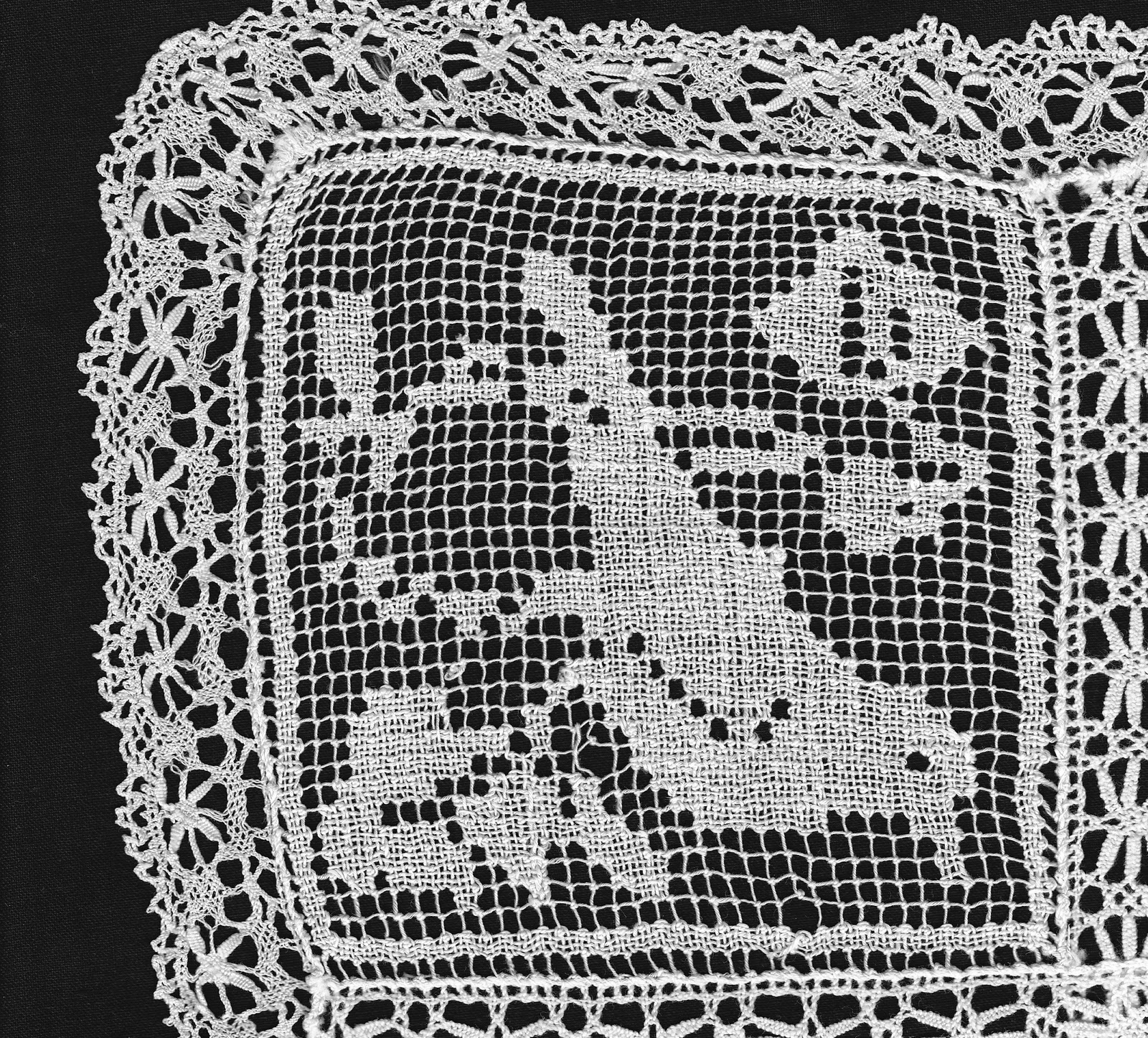
Filet or Buratto:  One of the earliest lace techniques.  The meshes are usually square and the motif  is embroidered using a darning stitch.  Variations in thread thicknesses could produce a shaded effect.

Needlepointed Laces: The basic unit to look for here is the buttonhole stitch, and so, if the lace looks as if it has been embroidered, it is probably a needlepoint lace.  This technique produces some of the most beautiful examples and many machine copies were manufactured in the 19th century.  Usually it is these laces that appear to embellish a Worth gown if the antique piece was not available.

Alencon:  Originally of French manufacture.  Extremely time consuming to produce.  At the 1867 exhibition a dress was shown made from this lace that took 40 women 7 years to complete!  Obviously, the mechanization of this lace made it very popular for mass consumption.

Brussels (above) "Point de Gaze":  One of the most delicate and expensive laces of the 19th century.  Look for fine threads creating rose medallions.  Buttonhole stitch protects and defines the cordonnet.

"Point de Colbert" (below):  Mid 19th century copy of the heavier Venetian points.  Characterized by the stiffness of the hand and large stitches.  None the less, incredibly beautiful.


Bobbin Laces:

"Genoese" The example below, is quite different from its 17th century namesake.  The central motif is the characteristic of the original that lends its name to this sample.  Like Valenciennes, it was used extensively for lingerie trims and insertions.


"Chantilly" (above):  Examples dating to the 18th century are extremely rare.  Characteristically black, the mordant used to set the colour contained iron which would later eat away at the fibers.  Specimens dating to the 19th and 20th century are plentiful and the lace is still manufactured today.  Naturalistic flowers and Neo-classical themes such as swags and putti are found in the older and better examples.

Edwardian recreation by author
"Honiton":  Forever associated with Queen Victoria through her royal patronage.  The toile, tape or ribbon like, is fixed by linking brides.  The design is worked over a cartoon to insure accuracy.  Much like "Battenburg" lace except finer.


Alan Suddon Collection

Coarser in texture, linen tape is linked by twisted stitches of linen or cotton thread.  Notice the button hole filler or "wheels".  Characteristic of this style of lace.

Edwardian Lace dress,
Metropolitan Museum
                                                                  
Original owner in dress above
Irish crochet lace:  A craft lace.  Usually of cotton, highly textured.  Motifs of roses typically joined by picoted brides.
1920 Lingerie dress, authors collection
Throughout the 20th century, lace has come and gone out of fashion.  Currently, it is enjoying a revival and while examples of hand made lace are beyond the pocket books of many of us, the art of lace making is still being practice by a select few who desire to keep this craft alive.  To them and their patience, I dedicate this blog.